How to Use AI to Be More Creative: Unlocking Innovative Thinking
Artificial intelligence (AI) is revolutionizing the way creative work is approached, offering unique tools to augment human creativity. By analyzing patterns, providing suggestions, and automating certain aspects of the creation process, AI allows individuals to focus on the high-level creative aspects of their projects. Outside traditional boundaries, AI leverages vast amounts of data to provide insights and inspirations that humans may not easily conceive. As such, integrating AI into the creative process can lead to innovative outcomes that push the envelope of what is traditionally viewed as creative work.
Understanding the relationship between AI and human creativity is fundamental to utilizing AI effectively. It involves recognizing the strengths and limitations of AI and its role as a collaborative partner rather than a replacement for human ingenuity. From content creation to design and media production, AI tools and platforms are increasingly accessible, enabling creators across various industries to enhance their processes and produce results that stand out.
Key Takeaways
- AI tools augment human creativity, providing new opportunities for innovation.
- Effective use of AI in creativity requires understanding its collaborative role.
- AI’s accessibility across industries transforms the creative process on a global scale.
Understanding AI and Creativity
Artificial Intelligence (AI) has revolutionized the way individuals approach the creative process by introducing tools that enhance human creativity. It invites a symbiotic relationship where machines and human imagination work synergistically, facilitating brainstorming and exploration of novel concepts.
The Relationship Between AI and Human Creativity
Creative professionals are finding AI to be a significant collaborative partner. AI tools offer capabilities such as pattern recognition and data processing at scales beyond human capability, which can stimulate new ideas and inspirations. They elegantly match the human need for generativity in artistic endeavors. For instance, AI can suggest variations in design, propose harmonic progressions in music, or assist with writing by offering vocabulary and phrasing suggestions. However, these tools do not replace the essential human touch but rather amplify it, as the final creative authority rests with the individual using AI.
Core Principles of Generative AI
Generative AI operates on fundamental mechanisms that differ from traditional software applications. At its core, it relies on machine learning algorithms to synthesize new content that it hasn’t been explicitly programmed to create. These systems are trained on vast datasets, enabling them to produce outputs that can mimic certain styles or generate completely new creations. The main stages include:
- Training: AI models are fed large amounts of data, where they learn patterns and relationships.
- Interpolation: Through this pattern recognition, AI can generate new outputs that are similar to, but distinct from, its training data.
- Interaction: Human creators adjust parameters or provide input, guiding the AI in the generative process to achieve a desired outcome.
The intersection of AI and human creativity lies at the heart of modern creative explorations, representing a tool that enhances the artistic process through generativity without supplanting the essential role of human vision.
AI Tools and Platforms for Creativity
Advancements in artificial intelligence have led to the development of tools and platforms that significantly enhance the creative capacities of individuals in various fields. These tools not only streamline workflows but also open up new possibilities for innovation in art, writing, design, and idea conception.
Leveraging DALL-E for Visual Art
DALL-E is a cutting-edge AI program developed to generate images from textual descriptions. Artists and designers utilize DALL-E to transform their creative concepts into visual representations with minimal effort. This machine learning model allows for rapid prototyping of ideas, providing a revolutionary way to explore visual creativity.
Exploring OpenAI’s ChatGPT for Writing
ChatGPT, created by OpenAI, is a conversational model designed to simulate how humans interact through writing. Writers, including editors and content.
Enhancing the Creative Process with AI
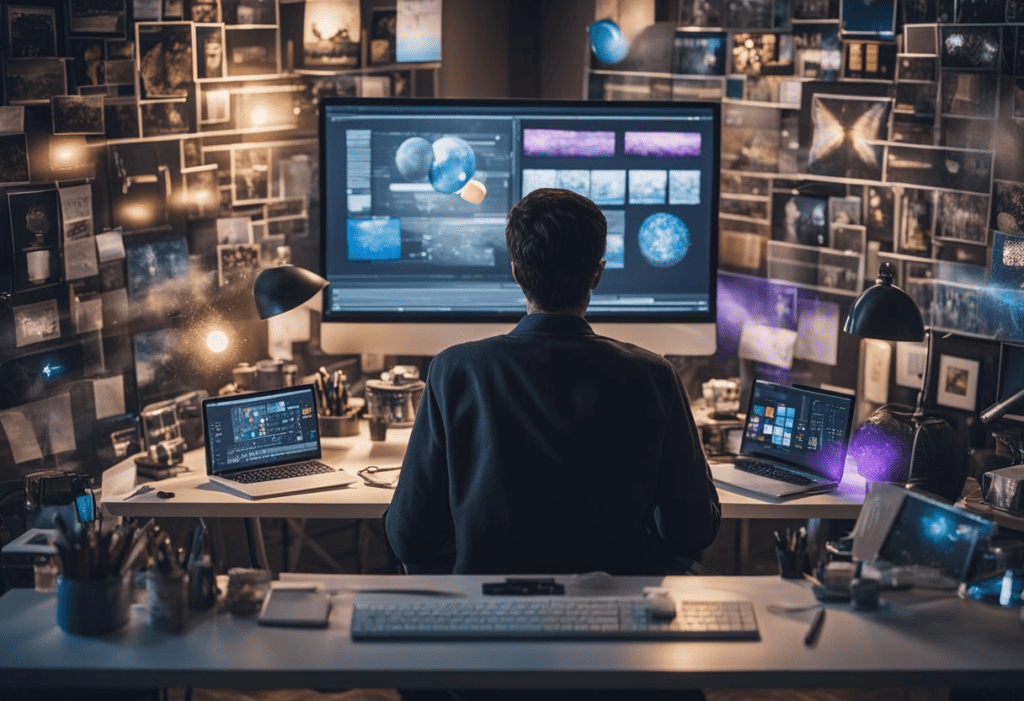
Artificial Intelligence is revolutionizing the creative process by enabling more efficient brainstorming, streamlining research, and offering novel ways to overcome creative blocks. Harnessing these tools can significantly enhance idea generation and creative output.
Boosting Brainstorming with AI
AI tools can transform how one generates ideas and expands concepts. Through the power of machine learning algorithms, they can offer a plethora of suggestions based on a set of input parameters. These suggestions can be wildly diverse, ranging from conservative to avant-garde, ensuring a breadth of ideas. For instance, AI can rapidly analyze and synthesize training data to suggest novel product ideas, resulting in a rich, varied pool of options that might not be immediately apparent through human brainstorming alone.
Streamlining Research and Data Analysis
The process of research is integral to grounding ideas in reality, and AI excels in aggregating and analyzing vast datasets. By utilizing AI, one can streamline the research phase, rapidly extracting relevant information from extensive data sources. This ability not only speeds up the process but also helps in uncovering hidden insights that can feed into the creative process, ensuring the final product is both innovative and informed.
Overcoming Creative Block with AI Assistance
A creative block can stifle the most talented individuals, but AI stands as a resourceful ally in navigating through it. Tools powered by AI can suggest prompts, continue incomplete work, or offer iterations on existing themes. By finessing the process of idea generation, AI support can break the deadlock of a creative block, propelling the creator forward when traditional methods may falter. This assistance is invaluable in maintaining momentum within the creative workflow.
Creative Domains and AI’s Impact
Artificial Intelligence (AI) is revolutionizing the way creativity is shaped across various domains, from generating literary works to composing music, and enhancing visual arts. AI facilitates the fusion of creativity and technology, resulting in groundbreaking applications that augment human capabilities.
AI in Literature: From Poetry to Novels
The impact of AI in literature is evident through tools capable of composing poetry and assisting in writing novels. Generative AI engines utilize deep learning algorithms, often trained on extensive literary datasets, to produce text that captures the nuance and rhythm characteristic of human writing. In poetry, AI contributes by suggesting lines that resonate with a given style or emotion, offering writers a diverse palette of expressions. Novelists can leverage AI to overcome writer’s block by providing plot suggestions or even generating entire chapters that align with the established narrative tone.
Music and Audio: Harmonizing with AI
AI’s role in music creation is not only about composing melodies but also about enhancing sound quality and inventing new genres. Machine learning models now dissect the structure of music, learning from patterns in rhythm, pitch, and harmony to create compositions that can harmonize with existing works or generate entirely new musical pieces. Musicians collaborate with AI to explore unprecedented sounds, with AI assisting in mixing and mastering tracks to achieve the desired acoustic effects.
Visual Arts: Style Transfer and Color Theory
The realm of visual arts has embraced AI through style transfer—a technique where the style of one image is applied to another—redefining approaches to art creation. By learning from masterpieces across art history, AI algorithms can imbue digital images with the stylistic nuances of iconic artists. Furthermore, AI assists artists in mastering color theory, providing suggestions that enhance their work’s visual impact. This synergy between human creativity and AI-generated insights is creating a new frontier in visual expression.
Ethics and Future of Creativity in the Age of AI
The intersection of artificial intelligence (AI) and creativity is redefining the creative industries, raising unique ethical concerns and shaping the future of human and AI collaboration.
Navigating the Ethics of AI-Created Content
When artificial intelligence enters the creative space, a key consideration is the ethical use of AI-created content. The principles of authenticity, attribution, and intellectual property are central to this discussion. As AI learns from existing human-generated data, content creators must ensure that their use of AI tools respects the original creators’ rights. Ethical quandaries also arise from the potential for AI to replicate human creativity without clear distinction or acknowledgment. This has catalyzed debates on whether AI should be considered a tool or a potential co-creator.
- Authenticity: AI algorithms must be transparent about the origins of the content they generate.
- Attribution: Clear guidelines are required to determine how to credit AI contributions.
- Intellectual Property: Defining ownership of AI-created works challenges current legal frameworks.
Predicting the Evolution of Creative Industries
Looking to the future, AI’s role in creative industries is poised to expand. It is not merely a question of whether AI will replace human creativity, but rather how it can augment it. Industries are forecasting that AI could lead to an era where mistakes are embraced as part of the learning curve and where human judgment is used to guide and refine AI outputs, rather than fearing AI as a replacement.
- Collaboration: Human-AI collaboration is seen as a potential catalyst for new forms of expression.
- Skill Development: AI could drive the creative industries to place greater value on uniquely human skills, like emotional intelligence and complex problem-solving.
Fear of AI in creative contexts may stem from concerns over job displacement, yet these industries are also recognizing the technology’s potential to unlock new opportunities. Ethical concerns will need to be balanced with inclusivity and accessibility, ensuring that AI serves as an empowering tool for creators across the globe.
FAQs
How can artificial intelligence enhance human creativity in various fields?
Artificial intelligence opens up a multitude of avenues for augmenting human creativity. In fields such as music, writing, and visual arts, AI can assist in generating new ideas, providing inspiration, and automating part of the creation process to allow for more focused ideation.
What are the limitations and ethical considerations when using AI for creative purposes?
The use of AI in creative endeavors is not without its limitations and ethical questions. Key issues include ensuring originality, preventing the reinforcement of biases, and respecting intellectual property rights as AI systems often learn from large datasets that may include copyrighted material.
In what ways can generative AI contribute to artistic and design industries?
Generative AI algorithms have the unique ability to produce novel content, from realistic images to original textual narratives. These technologies are revolutionizing the artistic and design industries by providing tools that can inspire fresh ideas and facilitate rapid prototyping.
What are some examples where AI has been used to innovate creative processes?
Creative processes have been reinvigorated by AI in numerous ways. For example, in fashion design, AI has been used to forecast trends and create personalized customer experiences. In gaming, AI drives dynamic storytelling and environment generation, making each player’s experience unique.
How can individuals tap into AI tools to augment their own creative abilities?
Individuals seeking to enhance their creative toolkit can utilize AI-powered software for tasks such as editing photos, composing music, or writing assistance. These tools can optimize workflows, aid in overcoming creative blocks, and refine the execution of their ideas.
What are the best practices for integrating AI into creative workflows?
Integrating AI into creative workflows effectively requires a strategic approach. Best practices include starting with clear objectives, maintaining an iterative process for both AI and human input, and continuously updating AI systems with new data to ensure relevancy and diversity in output.