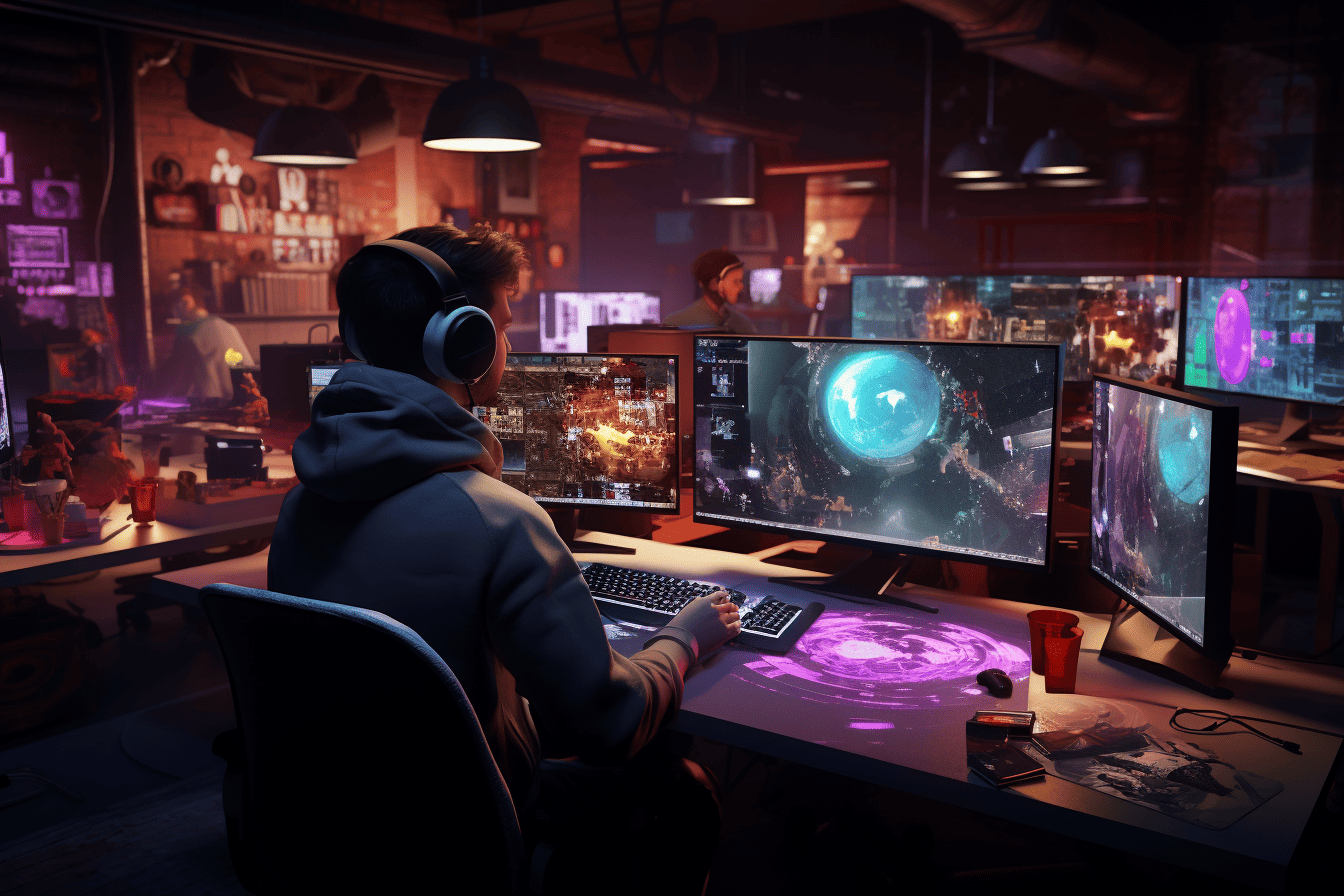
AI in Game Development: Unleashing Creativity and Innovation
The world of video game development is constantly evolving, and one of the most exciting advancements in recent years is the increasing integration of artificial intelligence (AI) into the process. From enhancing game design and character behavior to streamlining testing and creating more immersive experiences for players, AI has become an invaluable tool for developers everywhere.
As AI continues to improve and become more refined, its contribution to game development is expected to grow even more significant. Some of the most popular game titles already incorporate impressive AI-driven elements, and with the constant push for innovation, it’s intriguing to imagine what the future of AI in game development holds.
Key Takeaways
- AI is enhancing various aspects of game development, from design to testing.
- Popular games are already utilizing advanced AI-driven elements for a better player experience.
- The future of game development holds exciting possibilities as AI technology continues to evolve.
AI in Game Development
AI and Machine Learning
AI and machine learning are transforming the gaming industry by making games more immersive and engaging. With the help of generative AI, developers can create content like images, 3D models, audio, and animations, enhancing the gaming experience. Moreover, incorporating AI into games allows for adaptive learning and procedurally generated environments, keeping gameplay unpredictable and exciting.
Training Artificial Intelligence
To make an AI system effective in a gaming environment, it needs to be trained with a lot of data from various sources. This might include behavior patterns of players, in-game scenarios, and actions taken by characters. By learning from this data, the artificial intelligence can make informed decisions, react to different situations, and adaptively learn from the players’ actions.
Neural Networks and Reinforcement Learning
Some advanced AI technologies used in game development are neural networks and reinforcement learning. Neural networks are capable of processing and learning complex patterns and actions, making it suitable for creating in-game AI characters and companions. On the other hand, reinforcement learning involves teaching AI through trial and error, allowing it to learn specific tasks and strategies in a game, such as mastering a challenging level or defeating a powerful enemy.
In conclusion, AI technologies are significantly impacting the gaming industry by enhancing the overall experience for players. From creating dynamic environments to introducing adaptable AI characters, the possibilities are vast and have the potential to influence the future of game development.
AI for Game Design
Artificial intelligence is playing an increasingly significant role in game development, helping game designers create more immersive, dynamic, and engaging experiences. In this section, we’ll explore two aspects of AI that are revolutionizing the way games are designed: level and quest generation, as well as procedural and generative AI.
Level and Quest Generation
One of the most exciting advancements in AI for game design is the use of algorithms to automatically generate levels and quests. This is particularly beneficial for open-world games, where creating an expansive universe with numerous diverse locations and challenges can be a daunting task. By incorporating AI into the process, game designers can save time and resources.
For instance, AI can analyze existing level designs and learn patterns to generate new, unique areas that still feel cohesive with the game’s overall aesthetic. Similarly, AI algorithms can help designers create more realistic and engaging quests by adapting to players’ in-game actions and decisions. This can lead to more personalized experiences, as the game world and its challenges evolve based on each player’s choices.
Procedural and Generative AI
Another area where AI is making significant strides in game development is through procedural and generative techniques. Procedural AI involves using algorithms to create game content automatically, such as terrain, characters, or objects. This allows for an almost limitless amount of unique content, which can give players a fresh experience each time they play the game.
Generative AI, on the other hand, focuses more on creating characters, NPCs (non-playable characters), and enemy behavior. It uses artificial intelligence to create more authentic behavior patterns, making NPCs and enemies feel more realistic and human-like. This added depth to the game world can make it more engaging and immersive for players.
By leveraging these AI technologies, game developers are able to push boundaries when it comes to game design. The use of AI in game development is enabling designers to create more expansive, dynamic, and engaging worlds, which ultimately leads to more enjoyable experiences for players.
AI in Character Behavior
Simulating Emotions and Facial Expressions
AI has come a long way in creating realistic emotions and facial expressions for in-game characters. By using advanced algorithms and machine learning, game developers can now create intricate emotional expressions for both playable and non-playable characters (NPCs). This adds another layer of immersion and complexity to the gaming experience, making games feel more alive and connected to the player.
Developers often rely on motion capture technology paired with AI to transfer real-life emotions and expressions onto their digital creations. This innovative approach not only enhances the visual realism in games but also allows for meaningful, dynamic interactions between characters.
Non-Playable Characters and Pathfinding
AI plays a crucial role in developing intelligent NPCs. These characters need to respond to the player’s actions and the game environment in a believable and engaging manner. AI-powered pathfinding algorithms enable NPCs to navigate their surroundings efficiently, finding the best routes to reach their destinations or avoid obstacles.
These algorithms consider various factors like terrain type, distance, and potential hazards to calculate the optimal path. Moreover, AI allows NPCs to adapt their strategies and behavior based on changing game conditions or player interactions. This gives life to a more interactive and dynamic game world that helps keep the player engaged and entertained.
In summary, AI is reshaping the gaming industry by enhancing character behavior, simulating realistic emotions, and developing smarter NPCs. As technology continues to advance, we can expect even more sophisticated AI applications in the near future, pushing the boundaries of what is possible in video game development.
Creating Immersive Experiences
Artificial Intelligence (AI) is making a significant impact on the world of video game development. In particular, it’s enhancing the way immersive experiences are created for players. AI helps in crafting more engaging, dynamic, and lifelike gaming experiences in various game genres like role-playing games, simulators, and real-time experiences.
Role-Playing Games and Storytelling
AI has the potential to take role-playing games (RPGs) to a whole new level. With AI’s help, developers can create more realistic game environments and analyze players’ behavior and preferences, ultimately adjusting the game mechanics accordingly. For example, the Nemesis AI system developed by Monolith for its Middle-earth games allows enemies to remember their fights against the player, resulting in evolving blood feuds and dynamic gameplay interactions.
Simulators and Real-Time Experiences
When it comes to simulators and real-time experiences, AI is transforming the way players engage with the game world. By creating believable and complex game environments, AI enhances the immersive quality of these experiences. Artificial intelligence in gaming contributes to more accurate simulations and helps developers build worlds that are more deeply engaging.
So, whether it’s role-playing games or simulators, AI is undeniably playing a crucial part in elevating the immersive experiences in video games. As technology continues to evolve, we can anticipate even more dynamic and engaging gaming experiences in the future.
Technological Advancements
Notable AI Algorithms in Games
One of the most groundbreaking AI applications in gaming was AlphaGo. Developed by DeepMind, AlphaGo made history by defeating world Go champions, showcasing the strengths of AI algorithms in understanding complex game mechanics.
Another example of AI advancements in gaming is Watch Dogs: Legion. In this game, AI algorithms generate unique and diverse characters for players to interact with. These NPCs (Non-Player Characters) display individual behaviors, making the game’s world even more immersive and realistic.
OpenAI and ChatGPT
OpenAI has been working on developing AI technologies for various applications, including gaming. Their research covers topics such as generative models and reinforcement learning, both of which can significantly enhance in-game experiences.
One application of OpenAI’s technologies in gaming is ChatGPT, a cutting-edge conversational AI. ChatGPT can be used to create more engaging and intricate dialogues with NPCs, leading to more immersive storytelling and gameplay.
AI advancements in gaming technology continue to push the limits of what we can expect from games. From intelligent NPCs to impressive algorithms, these innovations improve in-game interactions and open up new possibilities for game developers. So, let’s grab a controller and enjoy the ride!
AI in Game Art
The rise of artificial intelligence in the gaming industry has paved the way for innovations in game art creation. From stunning visuals to unique audio landscapes, AI is revolutionizing how developers approach game design. Let’s dive into a few examples of how AI is being applied in different aspects of game art.
Animations and 3D Models
The use of AI in animations and 3D models speeds up the development process and allows for the creation of more realistic and engaging characters and environments. Take generative AI models for example, which are capable of generating intricate visual assets inspired by real-world references. The advantage of using AI-generated visuals is that developers can create custom art assets for their games in a fraction of the time and with less human input.
Audio and Text
Implementing AI-driven audio and text generation has a massive impact on the level of immersion and player experience. Natural language processing techniques can be used to generate believable dialogues and in-game narration, while AI-generated music and soundscapes elevate the game’s atmosphere.
For instance, AI-based audio engines can analyze a game’s environment and generate audio patterns that seamlessly blend with the surroundings. This technology makes it possible to have a virtually infinite number of audio possibilities, ensuring each player’s experience feels unique.
On the text front, AI-generated narratives can adapt to player choices, leading to dynamic storytelling that keeps players engaged and curious to explore different story outcomes. This type of AI-driven content generation not only creates a more personalized experience but also saves developers time in crafting multiple branching narrative paths.
AI has undoubtedly opened new doors in game development, offering creative solutions in the areas of animations, 3D models, audio, and text generation. As the technology continues to improve, we can expect even more impressive game art assets and immersive experiences for players.
AI in Game Testing
Improving Player Behavior
AI has proven to be a valuable asset in enhancing player behavior during game testing. By employing Deep Reinforcement Learning, developers can gather helpful feedback about game mechanics and design choices, making it easier to refine and adjust gameplay for an immersive experience (source: Playtesting with AI – a new game changer in game development). Additionally, AI algorithms can simulate various player profiles, which can speed up the testing process and help developers understand how different players interact with the game.
- AI-generated player behavior: Accelerates feedback and enhances game mechanics.
- Diverse player profiles: Simulates a wider range of players to understand interactions with the game.
Detecting and Fixing Glitches
One of the most prominent applications of AI in game testing is detecting and fixing glitches. AI-powered tools offer a more efficient way of identifying and resolving issues within games, ultimately leading to a smoother and more polished gaming experience for players. Some of the benefits of using AI in game testing include:
- Faster identification of game glitches and bugs.
- Improved game performance and stability.
- Automatic generation of bug reports to help developers pinpoint and fix issues.
Additionally, AI can be used to test video games through various algorithms and tools, such as character creation and UI tests (source: Hardcore Video Game Test Automation with AI Software). This helps ensure all possible options have been tried out and verified, thus reducing the chances of errors and glitches in the final product.
Using AI in game testing has the potential to revolutionize the gaming industry, offering developers better tools and techniques for creating immersive and engaging games while maximizing time and resources.
Popular Game Titles Featuring AI
The Sims
The Sims is a life simulation game series developed by Maxis and published by Electronic Arts. In these games, AI plays a significant role in controlling the autonomous actions of various characters, known as Sims. The AI’s primary task is to manage the Sims’ behaviors, making them respond to their environment and interactions according to their personalities, emotions, and needs. This “smart” AI system gives players a sense of realism and immersion, as the sims are constantly adapting and changing their actions according to the in-game context.
XCOM
XCOM is a popular turn-based strategy game series developed by Firaxis Games and published by 2K Games. AI plays an essential role in XCOM, as it controls the enemies’ actions on the battlefield. The AI in this game sires to provide challenging and engaging gameplay to the players by carefully analyzing each situation and devising appropriate strategies based on the players’ actions. As players progress through the game, the AI will adapt to their tactics, pushing them to constantly reassess and modify their approach in order to gain an advantage.
Electronic Arts Titles
Electronic Arts (EA), a leading video game publisher, has a history of incorporating advanced AI techniques into their games. Titles like FIFA and Madden NFL heavily rely on AI systems to control the behaviors and tactics of non-player controlled athletes. These AI systems create realistic and dynamic gameplay experiences by making in-game characters appear as if they have human-like reactions and decision-making abilities.
AI is also an essential part of EA’s Battlefield game series, where it manages the movements and actions of non-player-controlled soldiers, vehicle AI, and other game entities. AI helps create a dynamic, evolving gameplay experience, making each match feel unique and distinct from previous ones.
In conclusion, AI is revolutionizing the gaming experience, making games like The Sims, XCOM, and Electronic Arts titles more engaging, challenging, and enjoyable for players. As AI technology continues to advance, we can expect even more immersive and intelligent systems to shape the future of game development.
Future of AI in Game Development
Challenges and Opportunities
As AI technology continues to evolve, game developers are faced with both challenges and opportunities in incorporating it into the gaming industry. One of the main concerns for developers is the potential loss of jobs due to AI’s growing capabilities in game design and development. However, AI’s advancements also bring forth new ways to enhance gameplay experiences.
One significant opportunity is the improvement of in-game character behavior. With the help of AI, developers can create more realistic and complex interactions between characters and their environments. This adds a certain depth to the gaming experience, as seen in the evolution of video game artificial intelligence.
Emerging Technologies
AI researchers are exploring various AI technologies that can be implemented in the future of game development, pushing the boundaries of what’s possible in gaming. Some of these emerging technologies include:
- Procedural content generation: AI can generate new game content, such as levels, characters, and items on the fly, making games more unique for each playthrough. This approach makes gaming more dynamic and replayable.
- Dynamic difficulty adjustment: AI is being used to assess a player’s skill level and adjust in-game difficulty accordingly. This creates a more personalized gaming experience that keeps players engaged without becoming frustrated or bored.
- Photorealistic effects: AI is revolutionizing game development by improving graphics and rendering techniques, making games visually more immersive and realistic.
- Real-time strategy games: AI technology is being used in real-time strategy games to simulate complex decision-making processes, which makes games more intellectually engaging and competitive.
As game developers continue to collaborate with AI researchers, we can expect even more advanced and innovative applications of AI in game development. These advancements are likely to impact not only the gaming industry but also the way we interact with digital media as a whole.