OpenAI Sora: Unveiling the Next Generation of AI Video
OpenAI has pioneered numerous advancements in the field of artificial intelligence, and its latest breakthrough is capturing the attention of technologists and creatives alike. Called Sora, this generative model is reshaping the way videos are created by harnessing the power of diffusion models. Unlike traditional video production methods, Sora creates videos not by assembling frames sequentially but by transforming static noise into coherent, dynamic scenes. Its ability to extend the length of generated videos or produce them entirely from textual prompts positions it as a potential game-changer for a variety of industries, from entertainment to education.
Sora’s underlying technology leverages transformer architectures operating across both time and space, manipulating video and image latent codes to produce media of varying durations, resolutions, and aspect ratios. This versatility makes it particularly valuable in an era where content is consumed across an array of devices and platforms. OpenAI’s commitment to innovation can be seen in Sora’s capacity to generate high-fidelity videos up to a minute long, suggesting that the tool could significantly streamline the video production process and offer new avenues for storytelling and visual communication.
Key Takeaways
- Sora uses diffusion models to transform noise into dynamic videos.
- The tool integrates transformer architectures for content generation.
- Sora signifies a leap forward in AI-driven video production capabilities.
Overview of OpenAI Sora
OpenAI Sora represents a significant leap in generative AI, as this model possesses the ability to craft videos from textual input. By harnessing a diffusion model, Sora excels in creating content that begins as static visual noise, which it expertly transforms into coherent video sequences.
Key Attributes:
- Type: Diffusion Model
- Functionality: Generates and extends videos
- Developed by: OpenAI
This AI tool stands out due to its facility to generate not just short video clips but also longer sequences, thereby pushing the boundaries of video synthesis in artificial intelligence.
Capabilities:
- Generates entire videos or extends existing ones
- Maintains high visual fidelity
- Custom video duration up to a set limit
OpenAI has equipped Sora with the capability to intricately mimic the input instructions, offering users a novel form of expressive and dynamic content creation. It changes the landscape of AI-driven video production with each meticulously generated frame.
In the realm of generative AI, Sora is a testament to OpenAI’s continued innovation. It embodies a pioneering approach, reflecting OpenAI’s pursuit of expanding AI’s capabilities in multimedia. Sora’s proficiency in producing detailed, lengthened video content represents a new horizon for AI-generated media.
Sora’s Technological Foundations
Sora represents the convergence of advanced AI technologies, offering a novel approach to video generation. Its core lies in utilizing generative models to transform text descriptions into high-fidelity videos.
Generative Models and AI Capabilities
Generative artificial intelligence has been the backbone of a variety of OpenAI’s tools, including DALL·E and GPT-4. Sora takes this a step further by incorporating a diffusion transformer, which iteratively refines visual noise into coherent video content. This technique showcases the AI’s capabilities to understand and visualize complex narratives.
Text-to-Video AI Technology
The text-to-video model is an evolutionary step beyond static image generation, like that employed by DALL·E 3. It utilizes transformers and denoising techniques to generate not just brief clips but videos with impressive visual quality. This technology interprets textual input to produce detailed videos, expanding the horizons for visual artists and designers.
The Role of Artificial Intelligence in Creative Industries
Artificial Intelligence is increasingly becoming an instrumental tool for creative professionals, including filmmakers and visual artists. By generating metadata-enriched videos, Sora provides a new palette for designers to express ideas that were previously limited by traditional mediums. The new technology has the potential to open up unprecedented avenues for storytelling and visual exploration.
Artificial Intelligence and Public Interaction
With AI’s evolution, the public’s real-world interaction with artificial intelligence has soared. OpenAI takes a proactive approach to gauging public feedback via platforms like Twitter and its website, shaping the development and application of models like Sora. This continuous interaction ensures that AI technologies align with real-world applications and ethical considerations.
Sora’s Impact on Media and Content Creation
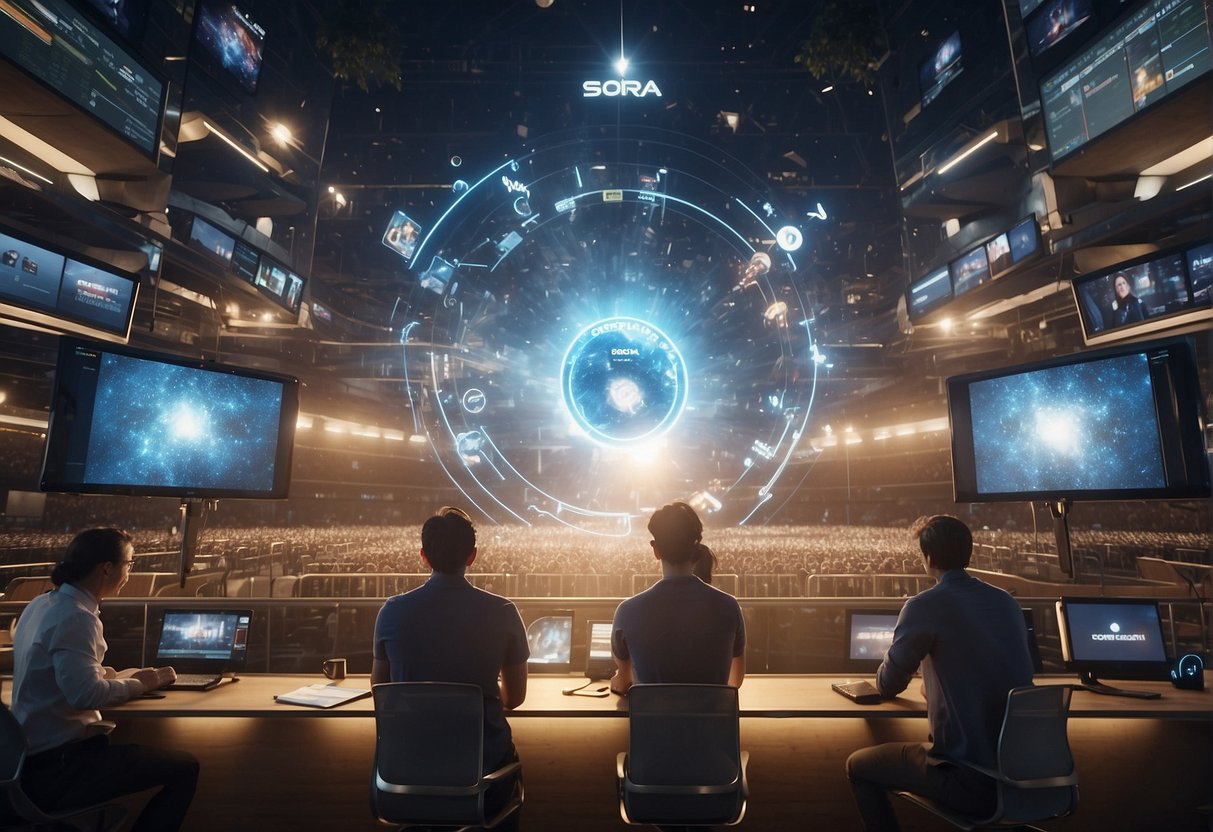
Sora, OpenAI’s versatile AI technology, is reshaping media and content creation by enabling the generation of AI-driven videos and redefining artistic expression. This technology harnesses the power of advanced models to create content across various domains, heralding a new era in the creative industry.
AI-Generated Videos and Cinema
With the advent of Sora, AI-generated videos can turn simple text prompts into intricate visual narratives, breathing new life into the arena of cinema and video production. Deepfake technology has also immensely benefited, as Sora’s capabilities allow for the creation of videos with intricate spatial details and vibrant emotions. This advancement opens up possibilities for filmmakers and creative professionals to produce content with unprecedented efficiency and customization.
Potential for Educational and Entertainment Content
Educational and entertainment content stands to gain significantly through the use of Sora, as it permits the creation of detailed visualizations ranging from the replication of historical events to the vivid representation of scientific concepts. For example, generating a video of a mountain ecosystem populated by various animals can become an interactive learning experience. Likewise, podcasting and entertainment domains can revolutionize storytelling by incorporating AI-generated visuals that engage the audience.
Influence on Artistic Expression and Design
Artists and designers can harness Sora’s technology to push the boundaries of artistic expression. Text prompts facilitate the generation of imagery that combines elements like oceans, wildlife, or abstract concepts, enabling creators to visualize complex and surreal art pieces. Moreover, fashion designers could leverage this to preview their clothing on virtual runways, experimenting with innovative designs before actual production.
Advancements in Text Prompts and Interactivity
Interactive content creation has taken a quantum leap with Sora’s advanced text prompts and Gen-2 diffusion model. Creators can now draft prompt ideas that translate into highly detailed and context-aware videos. This fosters a more engaging user experience, allowing creators to iterate rapidly based on user feedback and interaction, thus refining public use content to align better with audience preferences.
Expansion into New Content Domains
Sora is set to expand into new content domains, propelling areas like meta content creation and virtual real estate to new heights. By feeding the AI succinct text prompts, content creators could depict vibrant virtual worlds, offering an immersive experience. This expansion promises to redefine what’s possible in terms of visual content, setting a new benchmark for AI interaction and creativity.
Safety, Ethics, and Policy

When engaging with AI technologies like OpenAI Sora, safety, ethics, and policy considerations become pivotal to ensure responsible use. OpenAI has taken steps to address risks, mitigate harms, and uphold high ethical standards while navigating the relevant regulatory frameworks.
Addressing Risks and Harms of AI Technology
AI systems possess the potential for substantial impact, necessitating a proactive approach to identify and mitigate risks. OpenAI has developed techniques to prepare for deployments of technologies such as Sora, focusing on preventing harms before they occur. These techniques have been reinforced by safety measures drawn from products like DALL·E 3.
Combatting Misinformation and Disinformation
Combatting the spread of misinformation and disinformation is critical in the digital age. OpenAI emphasizes the importance of robust image classifiers to review content and maintain adherence to usage policies. This ensures that generated outputs from Sora do not contribute to the spread of false information.
Safeguards Against Unauthorized Uses
OpenAI implements strict safeguards against unauthorized uses of its AI model, including copyright infringement and fraud. Utilizing sophisticated text and image classifiers, the AI preemptively rejects prompts that could lead to the creation of hateful content or violate copyright laws.
Regulatory Considerations for AI
The development of AI technologies like Sora must navigate a complex landscape of regulatory considerations. OpenAI, under the leadership of CEO Sam Altman, engages with policymakers and legal experts to forecast and respond to potential lawsuits or changes in laws affecting AI deployment and usage.
The Role of Research and Red Teaming
Persistent research progress in AI safety and ethics is crucial. Researchers and red teamers work to uncover latent biases and expose vulnerabilities within AI systems. OpenAI’s commitment to these efforts is aimed at continually refining Sora and similar technologies to enhance their safety and ethical alignment.
Future Directions and Possibilities

The continuous evolution of AI technology, particularly in the realm of generative models, heralds a new horizon in how humans interact with digital content. OpenAI’s Sora is a pioneering testament to this transformation, stretching the limits of AI’s capabilities into the physical world.
Exploring AI’s Potential in Real-World Scenarios
The exploration of AI like Sora in real-world scenarios underscores its significant potential to create multiple characters and scenarios that seamlessly blend with reality. Its technological prowess could revolutionize industries such as film, where deepfakes have been a concern. The efforts are on ensuring that such powerful technology is used ethically.
The Evolution of Deep Learning and Generative Models
Generative models are experiencing rapid advancements, thanks to research organizations like OpenAI. This involves their AI model ChatGPT which, coupled with technologies like Sora, is reshaping the capabilities of AI models on a global scale, moving closer to achieving Artificial General Intelligence (AGI).
Potential Cross-Industry Collaborations
Cross-industry collaborations hold immense potential, opening doors for innovative applications of AI capabilities across various sectors. Collaborations between tech giants like Google and frontier AI technologies developed in places like Tokyo or reported by institutions like the New York Times could dramatically advance the model, influencing multiple aspects of society.
Long-Term Goals: Advancing AI Models
The long-term goal is clear: to advance AI models to a point where they can operate with high levels of understanding and autonomy. Real-world applications of AI stand to gain from such advancements, including industries seeking to integrate new technology into their operations.
Envisioning New Frontiers in AI
As AI capabilities continue to push the envelope, the vision for new frontiers in AI is expansive. From chatbots to sophisticated AI models like Sora, the potential for growth is boundless. One can envision a future where AI seamlessly integrates into the fabric of daily life, in both the digital and physical world.
Engaging with OpenAI Sora

OpenAI Sora represents a transformative advance in AI-driven video generation, offering significant opportunities for creative professionals and the general public to engage with cutting-edge technology.
Accessing and Using Sora for Content Generation
OpenAI Sora is a powerful AI model that empowers users to generate videos from textual descriptions. To access Sora, individuals can visit the OpenAI website, where detailed instructions guide through the process. This innovative tool boasts the ability to create up to minute-long videos, enhancing the toolkit available to filmmakers, visual artists, and designers.
Building a Community of Experts and Enthusiasts
Engagement with Sora extends beyond individual usage; OpenAI is fostering a community of domain experts and AI enthusiasts. By collaborating and sharing knowledge, members contribute to the model’s evolution. Twitter has become a popular platform for these interactions, hosting discussions and sharing creative outputs generated by Sora.
Opening Channels for User Feedback and Improvement
Feedback is crucial to advancing Sora’s capabilities. OpenAI encourages users to provide user feedback through various channels on their website, ensuring that the system’s consistency is continually refined and weaknesses are addressed. This open line of communication positions Sora for ongoing improvements, informed directly by user experience.
Opportunities for Creative Professionals
Creative professionals such as video producers and marketers have found Sora to be an indispensable tool, enhancing their ability to produce high-quality visuals with remarkable efficiency. The AI‘s adeptness at interpreting and rendering complex concepts into videos opens a new horizon of possibilities, particularly for those based in visually intensive fields like advertising and digital art in metropolitan hubs like Tokyo.
Frequently Asked Questions
In this section, you will find answers to common inquiries surrounding OpenAI Sora, providing clarity on aspects such as access, repositories, usage, and community discussions.
How can I log in to OpenAI Sora?
To log in to OpenAI Sora, users typically need to have access credentials, which may be provided during a limited release phase or once the service is publicly available.
Where can I find the OpenAI Sora GitHub repository?
The OpenAI Sora GitHub repository would typically be available on GitHub; however, access depends on OpenAI’s policy for sharing their code.
When was OpenAI Sora officially released?
The official release date for Sora can be found on OpenAI’s official communications or press releases. The product rollout is often announced via their news section or blog posts.
What are the steps to using OpenAI Sora effectively?
To use OpenAI Sora effectively, users should follow the provided instructions and guidelines, often detailed in the user manual or help documentation provided by OpenAI.
Where can I find discussions about OpenAI Sora on Reddit?
Discussions about OpenAI Sora can be located within relevant Reddit communities focused on machine learning and artificial intelligence.
How can I download OpenAI Sora for personal use?
When available, downloading OpenAI Sora for personal use would involve accessing the service through OpenAI’s official channels or platforms that may host the application for download.