AI Video Games: Revolutionizing Interactive Entertainment
Artificial intelligence, or AI, has played a pivotal role in the evolution of video games, transforming them into dynamic, immersive experiences.
The introduction of AI into video games goes back to their early development when simple behaviors needed to be automated for non-playable characters.
Today, the sophistication of AI technologies in gaming has continued to escalate, driving the industry towards increasingly realistic and responsive virtual worlds.
In contemporary gaming, AI is not only about programming NPCs to appear lifelike; it is about creating intelligent systems that can adapt to player actions and learn from them.
AI design and development have thus become fundamental elements of modern game creation, influencing game mechanics and the overall player experience.
While the implementation of artificial intelligence presents unique challenges such as computational demands and the complexity of creating believable behaviors, its impact on the gaming industry cannot be overstated.
Key Takeaways
- AI is integral to enhancing the realism and adaptability of video games.
- Development of sophisticated AI systems is key to evolving game design and mechanics.
- The implementation of AI in gaming continues to face technical and design challenges.
AI in Video Game History
Artificial intelligence (AI) in video games has evolved significantly since the early days of simple algorithmic challenges to now hosting complex enemies and virtual ecosystems. The history of AI in video games is marked by both the advancement of technology and creative milestones in game design.
Classic AI Games
- Pong (1972): It represents one of the earliest forms of game AI, with a simple paddle that reacts to the player’s movements.
- Space Invaders (1978): Amplified AI’s role with enemies that adjusted their difficulty as players progressed.
- Pac-Man (1980): Featured AI-controlled ghosts, each with distinct behavior patterns.
- Chess Programs: With AI entities like IBM’s Deep Blue, chess demonstrated the contemplative potential of AI in gaming.
AI Milestones in Gaming
- DOOM (1993): Revolutionized AI in first-person shooters with enemies that exhibited basic tracking and response tactics.
- FPS Advancements: Later advancements included Halo‘s AI, known for its highly realistic responsiveness.
- Snake (Mobile Phones): Although AI was not its core, Snake influenced AI applications for its simplicity and decision-making execution within games.
AI Technology in Modern Gaming
Artificial intelligence has become a cornerstone in modern gaming, enhancing player experience by introducing more realistic behavior in non-player characters (NPCs) and creating adaptive, complex game worlds.
Machine Learning and Deep Learning
Machine learning (ML) and deep learning, subdivisions of AI technology, allow video games to provide dynamic difficulty adjustments and tailored experiences to individual players.
For example, these technologies enable NPCs to learn from players’ actions and patterns, resulting in more challenging and engaging gameplay.
Moreover, the use of deep learning has led to the development of sophisticated in-game elements that can evolve without needing explicit programming.
Neural Networks and Game Development
Neural networks, which are vital to deep learning, have revolutionized game development by enabling the crafting of environments and characters that respond more authentically to player actions.
These networks mimic the human brain’s structure and function, allowing games to process complex information, such as interpreting visual data to automate character movements or environmental responses.
Natural Language Processing in Games
Natural language processing (NLP) makes it possible for NPCs to understand and respond to voice commands or typed input from the players.
This AI component enhances the interactivity within the game world, creating opportunities for players to communicate with game characters in a natural, intuitive manner.
Behavioral AI and NPCs
Behavioral AI plays a significant role in determining how NPCs interact with the game environment and the player.
Through intricate decision-making processes and behavior modeling, NPCs exhibit lifelike reactions and actions, leading to a more immersive gaming experience.
The application of behavioral AI allows NPCs to perform complex tasks and exhibit adaptive learning behaviors, providing a distinctive touch to each gaming session.
AI Design and Development

Artificial Intelligence (AI) is a driving force in modern video game development, greatly enhancing the depth and complexity of gameplay.
Innovative algorithms and refined code empower game developers to elevate the entire gaming experience.
Game Designers’ Approach to AI
Game designers utilize complex algorithms to create intricate behaviors and more lifelike characters in games.
This approach often involves writing extensive code to facilitate intelligent decision making and interactions within a game’s environment.
They focus on creating AI systems that are both challenging and believable, enhancing the player’s immersion in the game’s world.
Pathfinding and Decision Making
Pathfinding is a crucial aspect where AI navigates characters through the game’s world by calculating the most efficient routes to a destination.
Game developers implement algorithms like A* or Dijkstra’s for this purpose, enabling non-player characters (NPCs) to overcome obstacles and interact dynamically with the player and the environment.
Effective decision making is another key AI element, allowing NPCs to respond to player actions or changes in the game state intelligently and in real-time.
Procedural Content Generation
Many game developers turn to procedural content generation to create varied and expansive game worlds.
AI algorithms are designed to generate environments, levels, and even story elements algorithmically, providing a unique experience with each playthrough.
This not only saves on development resources but also adds to the replay value of a game.
AI-driven Storytelling and Dialogue
Finally, AI significantly impacts storytelling and dialogue in games.
Game developers code complex AI systems to control the flow of the narrative, allowing for dynamic and responsive storytelling that adapts to the player’s choices.
AI-driven dialogue systems use natural language processing to facilitate more natural and context-sensitive conversations with NPCs, enriching the game’s narrative depth and the player’s engagement.
AI Systems in Game Mechanics
Artificial Intelligence has become integral to the development of game mechanics, enhancing game design and player interaction.
It utilizes various techniques and algorithms that allow for advanced behavior and emotionally rich characters within the gaming world.
Reinforcement Learning in Games
Reinforcement learning allows game AI to optimize its behavior by rewarding desired outcomes as it engages in interaction within the game environment.
For example, an AI-controlled character might learn to navigate a complex maze faster over time, owing to the reinforcement of positive movement patterns, continuously adapting and improving its strategy to achieve objectives efficiently.
Finite State Machines and AI Behavior
Finite state machines (FSMs) are algorithms that enable video game characters to shift between a finite number of predefined states based on inputs or conditions.
This can be seen in the movement patterns of non-player characters (NPCs) who patrol areas, react to player actions or change their tactics during combat.
The FSM approach is vital for creating predictable and debuggable AI behaviors that appear complex and lifelike.
Emotion and Character AI
AI can also be programmed to simulate emotions and personalities in games, creating NPCs that respond to in-game events with contextually appropriate emotions.
These characters can display fear, aggression, or joy, making them more engaging and enhancing the overall immersive experience.
AI-driven emotion models contribute to the development of storylines and character interactions that capture and retain player interest.
AI Implementation Challenges

Integrating advanced AI into video games presents distinct challenges that game developers must overcome.
This section examines the intricate process of creating realistic non-player character (NPC) behaviors, balancing the difficulty of AI, and addressing the ethical implications of AI use in gaming.
Creating Realistic NPC Behaviors
Game developers strive to construct NPCs with behaviors that mimic real life, contributing to immersive gameplay experiences.
This involves intricate decision trees and behavior patterns that react to player actions.
For realistic NPC behavior, developers must encode a wide array of potential responses to account for unpredictable player interactions, making the process complex and resource-intensive.
Balancing AI Difficulty
The goal of balancing AI difficulty is to challenge players without causing frustration.
When AI is too easy, players lose interest; too hard, and the game becomes inaccessible.
The key is to develop AI that adapts to individual player skill levels, offering a tailored challenge that evolves as the player improves. Achieving this balance requires thorough testing and refinement.
Ethical Considerations in AI
Ethics guide the responsible use of AI in video games.
Developers face moral questions such as: Should AI manipulate player behavior for engagement? What is the impact of AI on player mental health?
To address ethical considerations, developers must establish clear guidelines ensuring AI enhances gameplay without exploiting or harming players, maintaining a focus on player well-being.
Impact of AI on the Gaming Industry

The advent of artificial intelligence has unleashed a wave of transformative effects in the gaming industry, evidenced by the new breed of AI-generated games and technologies from both tech giants and smaller innovators. This dichotomy showcases a landscape of rich and varied AI applications in gaming.
The Role of Tech Giants in AI Gaming
Tech giants leverage their extensive resources to advance AI in gaming, bringing sophisticated algorithms and infrastructure that power more immersive and interactive gaming experiences.
For instance, adaptive AI technology employed by developers allows for tailoring challenges and narratives dynamically, adjusting to individual playing styles to keep the player engaged.
With the influence of these major industry players, AI-driven technologies such as natural language processing and machine learning models are integrated into mainstream titles, offering gamers unprecedented levels of realism and personalization.
Innovations by Indie Developers and Startups
Indie developers and startups, on the other hand, approach AI in gaming with fresh perspectives and innovation-driven cultures. These smaller entities often focus on niche segments and experiment with AI, pushing the boundaries of traditional gameplay.
They utilize reinforcement learning to train AI agents, not only improving in-game AI opponents but also using AI to enhance game-testing effectiveness. This ensures a polished end product.
Such agile and creative environments foster novel AI-powered game mechanics and storylines, expanding the gaming industry’s horizons beyond the mainstream market.
Emerging AI Technologies in Gaming
The gaming industry is witnessing a transformative phase with the advent of innovative artificial intelligence technologies. These advancements are not only redefining gameplay but are also enhancing player experience through personalization, realism, and interactivity.
Generative Adversarial Networks (GANs)
Generative Adversarial Networks (GANs) have paved the way for creating hyper-realistic game environments. Through GANs, developers can now design detailed textures and landscapes that blur the line between virtual and reality.
For instance, GANs are instrumental in developing intricate in-game assets automatically, leading to richer, more diverse virtual worlds.
Ubisoft’s Nemesis System
One of the groundbreaking uses of AI in gaming comes from Ubisoft’s Nemesis System. This technology gives non-playable characters (NPCs) a memory of player interactions, leading to a unique, personalized experience.
Each encounter with these NPCs is tailored to past events, creating an evolving and dynamic storyline affected by player choices.
AI in Facial Recognition and Emotions
AI has brought new depths to character design through facial recognition and emotions. These systems can detect player expressions through cameras and reflect them on characters in real-time.
This enhances the emotional engagement by aligning the player’s real-world reactions with their in-game counterpart’s expressions and responses.
Natural Language Processing and ChatGPT
At the core of interactive dialogues in games stands Natural Language Processing (NLP), with tools like ChatGPT leading the charge.
They enable games to feature complex, engaging conversations with NPCs, making the narrative experience more immersive.
Through NLP, in-game characters understand and react to player input in a coherent, context-aware manner.
AI Contributions to Game Genres
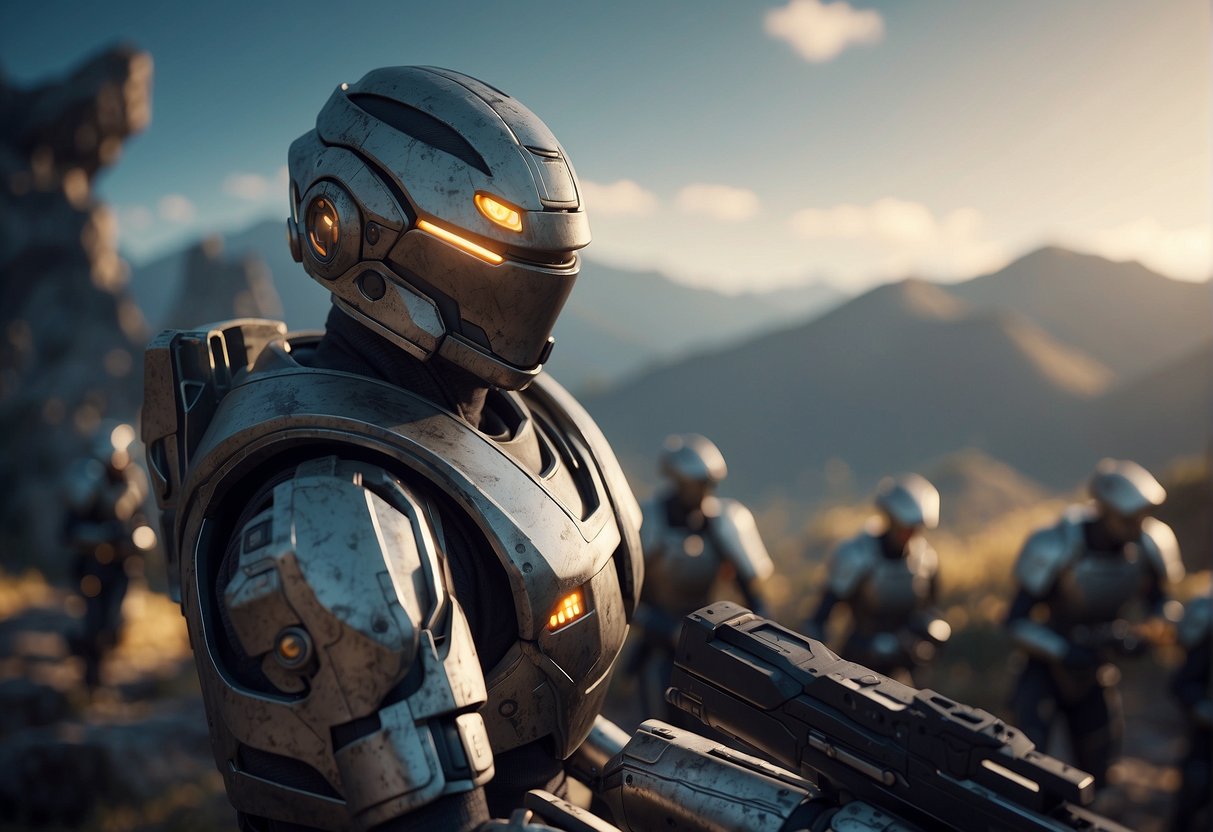
Artificial Intelligence has reshaped various video game genres, creating immersive experiences and challenging gameplay for players. From strategic decision-making to dynamic storytelling, AI’s integration caters uniquely to each genre’s demands.
Strategy and Civilization
In strategy games, AI opponents often use complex algorithms to provide a challenging and realistic opponent, ensuring replayability.
Games like Civilization have advanced AI that can manage empires, engage in diplomacy, and wage war with a strategic depth that mimics human-like foresight and adaptability.
- Decision-Making: AI rapidly calculates optimal strategies, which can involve resource management, military tactics, and diplomatic relations.
- Difficulty Levels: The AI can adjust its level of challenge based on the player’s proficiency and selected difficulty.
Role-Playing and Open-World Games
AI in open-world games like Red Dead Redemption 2 and The Last of Us is central to creating believable worlds and dynamic character behaviors.
AI-driven non-player characters (NPCs) populate these worlds, bringing life to stories and environments.
- Narrative Development: Sophisticated AI systems guide NPCs to react and evolve based on player interactions, enhancing the storytelling aspect.
- Realistic Environments: These games simulate intricate ecosystems where AI behaviors enhance the player’s immersion in the game world.
Sports and Life Simulation Games
In sports games, such as FIFA, AI improves realistic gameplay by simulating the unpredictable nature of sports. It controls the actions of non-controlled players, providing a fluid and realistic gaming experience.
- Tactics and Teamwork: AI coordinates team movements and strategies, mimicking real-life team dynamics and sports tactics.
Life simulation games such as The Sims utilize AI to help control the myriad of autonomous characters and their interactions, creating a unique storyline for each playthrough.
- Character Interactions: AI dictates the social dynamics within the game, managing relationships and character needs in a way that reflects human behavior.
Interactive Experiences and AI
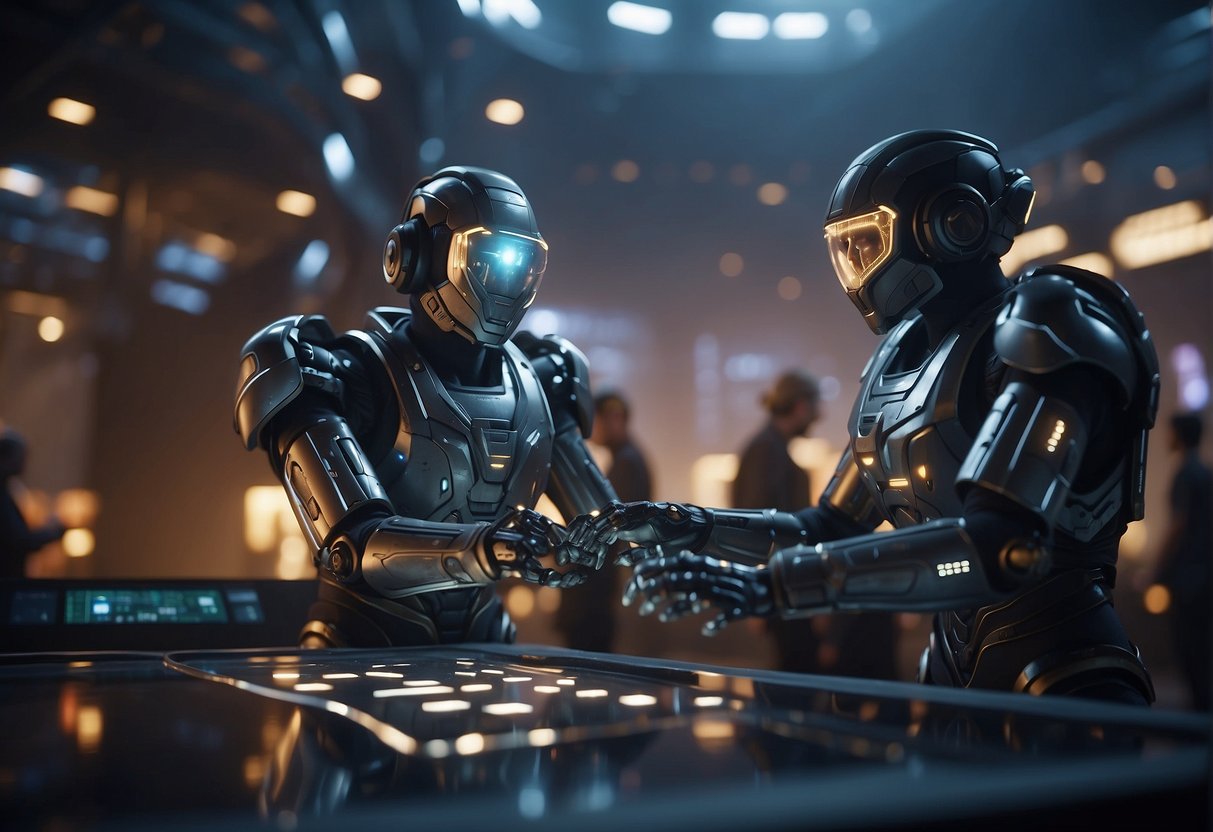
In the realm of video games, AI is a game-changer, providing avenues for more compelling interactive experiences. This sophistication comes in the form of user-generated content, dynamic narratives, and adaptive experiences, reshaping the landscape of gaming.
User-Generated Content
AI enables players to become creators within their favorite game worlds. By leveraging AI tools, players can design complex levels, characters, or objects, fostering a more engaged and invested community.
For instance, AI-powered systems can assist in automatically balancing user-created levels to ensure they are playable and challenging for a wider range of players.
Dynamic Game Narratives
Game writers are tapping into AI to produce dynamic storytelling. These narratives pivot and morph based on player decisions, creating a personalized story arc that can change the outcome of the game.
AI-driven characters can react organically to player actions, crafting a unique experience that feels different on every playthrough.
Adaptive Gaming Experiences
AI contributes to adaptive gaming experiences by adjusting game difficulty, pacing, and challenges in real-time.
These adaptive experiences are tailored to the individual’s play style, maintaining a balance between challenge and playability.
AI systems can analyze player behavior to introduce new obstacles or aids, ensuring that the game remains engaging throughout.
The Future of AI in Video Games
Advancements in artificial intelligence will greatly diversify the way games are developed, played, and experienced. These innovations hold the potential to revolutionize the gaming industry.
Potential AI Developments
In the realm of potential AI developments, it is anticipated that machine learning techniques will enhance non-player characters (NPCs) with deeper learning capabilities. This will allow for more complex interactions and behaviors.
Future games may feature intelligent adversaries or allies that adapt to players’ actions in real-time. This will provide a unique and dynamic gaming experience with each playthrough.
The anticipation of AI systems that can understand and interpret player emotions through biometric feedback could lead to games that adjust difficulty or narrative based on the player’s responses.
AI as Game Creators
Focusing on AI as game creators, there’s a future where AI could play a significant role in game design and development.
This may involve the generation of infinite landscapes and storylines or assistance in coding through advanced predictive algorithms.
Game creators might collaborate with AI to produce content rapidly, catering to players’ preferences and feedback. This partnership could expedite the creative process and introduce an array of personalized gaming experiences.
AI and the Evolution of Gaming
Considering the evolution of gaming, AI is expected to drive immersive realities to new levels by advancing virtual and augmented reality experiences.
The integration of AI could lead to games with environments that respond to player presence or actions in subtle and realistic ways, further blurring the line between the virtual and real.
The combination of AI with futuristic technologies like neural interfaces might allow players to control games using their thoughts, redefining the bounds of player engagement.
AI Industry and Market Insights
The burgeoning AI sector is influencing the video game industry in tangible ways, from enhancing marketing strategies to providing detailed analytics that inform major investment decisions by industry leaders.
AI’s Influence on Game Marketing
AI propels game marketing to new levels of personalization and targeting.
Companies harness AI to generate dynamic advertisements that resonate with individual preferences, increasing engagement and conversion rates.
According to Bain’s insights, AI-driven marketing is becoming increasingly sophisticated, helping gaming companies tailor their approaches with unprecedented precision.
AI in Gaming Analytics
Analytics are key in understanding player behavior and game performance.
AI excels in this area, parsing through large datasets to offer actionable insights.
For instance, Electronic Arts (EA) may analyze player data to fine-tune experiences and drive retention, which was discussed in Allied Market Research’s report, while Sonantic’s voice AI can provide analytics on player emotional engagement.
Investment in AI by Gaming Giants
The investment in AI technology by gaming giants is both strategic and substantial.
Microsoft’s acquisition of AI companies indicates its commitment to integrating AI into its gaming products. Meanwhile, companies like Electronic Arts invest in AI for more lifelike and responsive game environments, foreseeing a future where AI is integral to the game development life cycle, as mentioned in the research by Dataintelo.
Frequently Asked Questions
In this section, we explore commonly asked questions about the intersection of artificial intelligence and video gaming, offering insights into how AI technologies are applied and what their evolution means for the future of gaming.
What are some examples of artificial intelligence in video games?
Artificial intelligence in video games often manifests through non-player characters (NPCs) that exhibit behavior mimicking real human reactions.
Games like Minecraft and Grand Theft Auto utilize AI to create complex, responsive environments.
How is AI used in game development?
In game development, AI is employed to automate tasks, from procedural content generation that creates infinite landscapes to balancing game difficulty.
For instance, AI can aid in dynamically adjusting challenges in real-time to fit a player’s skill level, allowing for a more personalized gaming experience.
What are the benefits and disadvantages of using AI in gaming?
One benefit of AI in gaming is the enhanced realness and depth it brings to games, as it allows NPCs to act more intelligently and unpredictably.
However, AI can also lead to higher development costs and potential unpredictabilities in gameplay, which could negatively impact user experience.
Which video games are known for having the best AI?
Certain games stand out for their exceptional AI, such as The Last of Us, which is renowned for its sophisticated enemy NPC behaviors that strategize and adapt to player actions.
Can artificial intelligence create entire video games independently?
As of now, AI can contribute to the creation of games but cannot independently design and produce a complete video game. The creative and complex decision-making process in game development still requires human oversight.
What is the future potential of AI in the gaming industry?
The future potential of AI in gaming appears formidable. Projections point towards more adaptive, personalized gaming experiences and incredibly life-like NPC behaviors. AI might also revolutionize game testing. It could automate the debugging process and provide unique user playtesting at scale.